

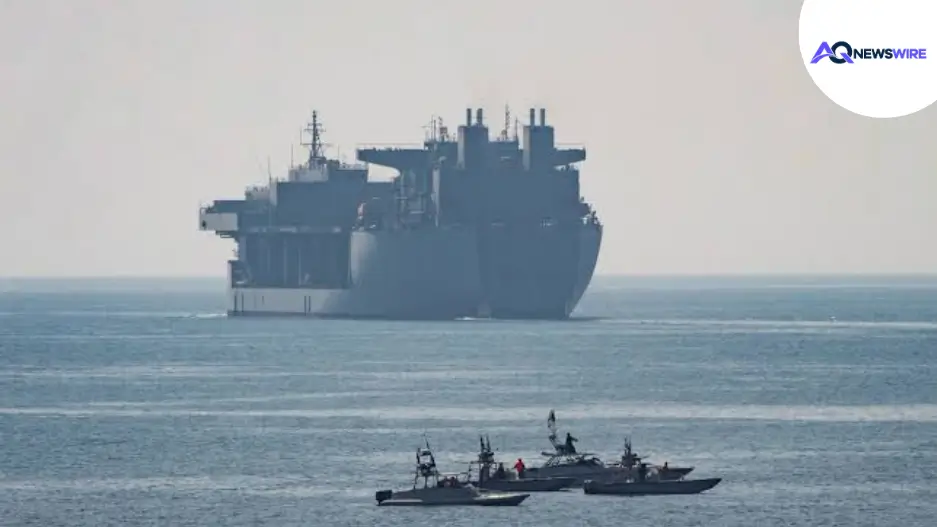
Rising Tensions and Threats in the Persian Gulf
Geopolitical friction across the Middle East surged to dangerous new heights following a dual wave of military escalation: an explicit threat from Tehran targeting the United States Navy in the Strait of Hormuz, and a series of cross-border missile strikes that hit the administrative heart of Saudi Arabia’s energy sector.
Rear Admiral Ali Ozmaei, a senior naval commander within Iran’s Islamic Revolutionary Guard Corps (IRGC), issued a combative warning to Washington, declaring that Iranian forces are actively preparing for a direct confrontation with American naval assets. Addressing the ongoing military standoff in the Persian Gulf, Ozmaei stated that Tehran’s naval units are waiting for an opportunity to strike U.S. vessels and challenged American commanders to bring their fleets closer to the Strait of Hormuz if they wish to test Iran's defensive capabilities. He further asserted that multi-billion-dollar U.S. aircraft carriers are avoiding the strategic chokepoint out of fear of Iranian retaliation.
CENTCOM Rejects Tehran's Maritime Claims
United States Central Command (CENTCOM) swiftly dismissed Tehran’s claims of regional dominance. American defense officials rejected the assertion that the Islamic Republic controls the vital maritime corridor, noting that U.S. naval forces, operating alongside international coalition partners, successfully escorted and facilitated the transit of more than 19 million barrels of crude oil through the waterway in a single day just prior to the IRGC’s statement. The Strait of Hormuz remains the world’s most critical energy transit point, handling roughly a fifth of global petroleum trade, making any threat of naval blockade an immediate trigger for international markets.
Missile Strikes Target Saudi Energy Infrastructure
While Washington and Tehran traded warnings over maritime security, violence escalated sharply on the Arabian Peninsula. Saudi officials confirmed that an overnight missile attack targeted an administrative building belonging to state oil giant Saudi Aramco in the eastern city of Dhahran. Dhahran serves as the historic nerve center of the kingdom’s vast petroleum industry. While the strike sparked a blaze at the facility, emergency crews contained the fire quickly and authorities reported no casualties at the complex.
Houthi Air Raids Reach the Saudi Capital
The strike in Dhahran was part of a broader, intensifying aerial campaign launched by Yemen’s Iran-aligned Houthi movement against Saudi infrastructure. In the Saudi capital of Riyadh, residents received emergency mobile alerts warning of an incoming hostile aerial threat shortly before loud explosions echoed across the city. Saudi Arabia’s civil defense agency reported that air defense systems intercepted two Houthi cruise missiles over the capital. However, falling shrapnel and debris damaged 15 residential homes and injured four civilians, including two women, a man, and a child.
The renewed strikes compound a week of severe disruptions across the kingdom. According to the Saudi Ministry of Energy, repeated aerial attacks targeting aviation infrastructure in Riyadh over the past several days have resulted in fatalities, widespread property damage, and hundreds of flight cancellations, forcing authorities to keep King Khalid International Airport closed through Saturday.
Coalition Retaliation and Global Market Impact
In response to the cross-border barrages, the Saudi-led military coalition launched retaliatory airstrikes against Houthi-controlled infrastructure in Yemen. Coalition warplanes targeted a fuel station in the rebel-held capital of Sanaa—sending a massive fireball into the night sky—and struck loading piers at the strategic Red Sea port of Hodeidah. Coalition spokesperson Major General Turki Al Malki stated that the strikes were aimed at cutting off vital resources used by the militia to sustain its offensive operations.
Global energy markets reacted immediately to the twin developments in Dhahran and the Strait of Hormuz. Crude oil benchmarks climbed as energy traders weighed the risk of sustained damage to Saudi production facilities alongside the potential for direct military clashes in the Gulf’s shipping lanes. With regional proxies expanding their reach and military commanders issuing ultimatums, diplomatic observers warn that the margin for miscalculation in the Middle East is narrowing rapidly.



