

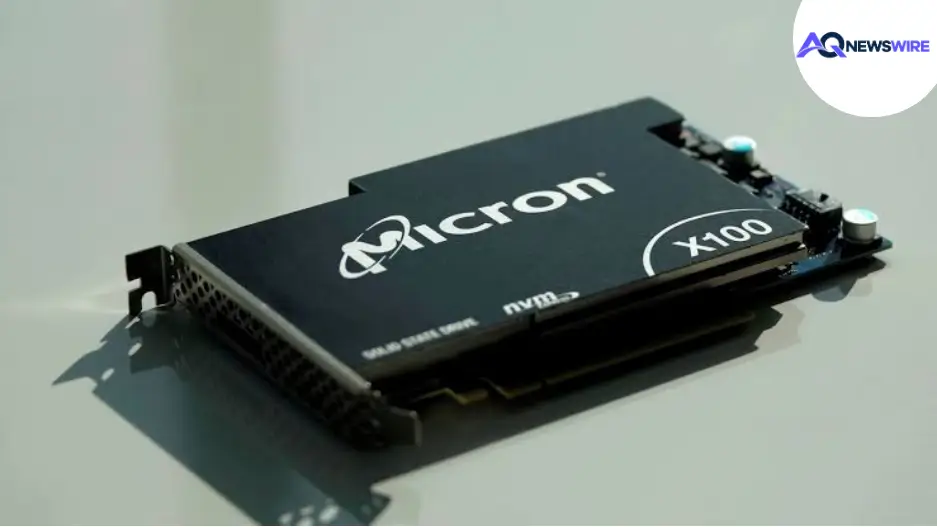
A brutal global selloff in semiconductor stocks intensified on Tuesday, erasing billions in market value as anxiety over an overheated artificial intelligence (AI) trade rippled through international markets. Heavyweights including Micron Technology, SoftBank Group, and ASML Holding found themselves caught in the crosshairs of a widening tech rout. What began as localized weakness on Wall Street quickly spilled over into Asian and European trading sessions, marking a sharp reversal for a sector that has driven global equity markets to record highs for much of the year.
The China Catalyst: CXMT’s Breakthrough
The primary trigger for the acute weakness in memory stocks—particularly U.S.-based Micron Technology—is the unexpected emergence of formidable Chinese competition. Over the weekend, Chinese state-backed chipmaker ChangXin Memory Technologies (CXMT) announced substantial progress in the development of a next-generation DRAM cell design utilizing a vertical gate transistor. Furthermore, the company’s leadership stated their goal to launch a server memory product based on this new architecture by the end of 2026.
Research firm TrendForce estimated that this new design could increase memory density by a staggering 30% to 50%, allowing much more data to be packed into a smaller physical space. For years, the memory chip market has been an oligopoly dominated by three established players: Micron, SK Hynix, and Samsung. CXMT’s breakthrough has raised serious alarms on Wall Street that this comfortable dominance is under threat. If China can successfully domesticate the production of advanced memory chips, it could lead to an oversupply in the global market, severely compressing the profit margins that the major players have enjoyed during the AI surge.
Consequently, Micron faced intense downward pressure. After sliding 3.9% during Monday's regular session, the Idaho-based memory manufacturer dropped an additional 2.3% in Tuesday's premarket trading. Investors are rapidly pricing in the risk that Chinese technological autonomy could structurally alter the memory market's economics long before the AI capital expenditure super-cycle concludes.
Asian Markets Take the First Hit
The latest wave of selling heavily impacted Asia, where memory chip giants bore the brunt of the market's sudden risk aversion. In South Korea, the prospect of tougher Chinese competition in high-value server memory hit incumbents hard. Industry leader SK Hynix saw its shares plunge approximately 4.5%, while its primary domestic rival, Samsung Electronics, tumbled roughly 4%. This widespread tech selloff was a major factor in pulling South Korea's Kospi index down by a significant 3.65%.
The bearish sentiment quickly bled into the Japanese market, heavily impacting technology-focused investment conglomerate SoftBank Group, which slid alongside the broader chip sector. SoftBank is highly sensitive to shifts in the broader AI narrative, and the sudden contraction in Asia served as a grim prelude to the trading day in Europe and North America, setting a distinct risk-off tone across global equities.
European and Wall Street Contagion
The contagion swiftly crossed continents. In Europe, shares of ASML Holding—the Dutch manufacturer that holds a virtual monopoly on the extreme ultraviolet (EUV) lithography machines required to manufacture the world's most advanced chips—slid in early trading as the rout spread. While ASML is fundamentally insulated from direct memory chip price fluctuations, the broader fear that global foundries may scale back their ambitious capacity expansion plans weighed heavily on the equipment maker's stock.
By the time Wall Street prepared for the opening bell on Tuesday, the red ink was ubiquitous across the U.S. semiconductor landscape. During Monday's regular session, the technology-heavy Nasdaq Composite fell 0.44% to close at 27,245.90, underperforming the Dow Jones Industrial Average and the S&P 500 due to its heavy weighting in semiconductor and AI-related stocks. The Philadelphia Semiconductor Index fell about 2.6% to a three-week low during that session. Beyond Micron, other major players suffered notable losses; Advanced Micro Devices (AMD) and Marvell Technology fell more than 3%, while SanDisk and Lumentum slid roughly 7%. In Tuesday's premarket action, Marvell and SanDisk continued to slide, dropping more than 2%.
Macro Pressures: Oil and AI Sentiment Reassessment
Beyond the localized threat of Chinese competition, the broader tech sector is grappling with a sobering reality check regarding the AI revolution. The current move extended a run of nervousness about AI spending that began late last week when lower-than-expected revenue disclosures from OpenAI prompted investors to reassess valuations across the entire AI supply chain. The market is shifting its focus to how these staggering capital expenditures will be financed, and whether end-user software demand will generate sufficient returns on investment to justify the trillions being poured into silicon and infrastructure.
Adding fuel to the fire, macroeconomic headwinds are mounting. Higher oil prices have added immense pressure on growth stocks, with Brent crude rising toward $107 a barrel following weekend Houthi strikes on Saudi Arabia and Russian attacks on Ukrainian power plants. This spike in energy costs has revived inflation concerns at a time when the 10-year Treasury yield is hovering near its highest level since 2002.
The simultaneous slide of Micron, SoftBank, and ASML underscores a pivotal moment for global equity markets. The semiconductor sector, once viewed as an unstoppable juggernaut fueled by infinite AI demand, is now colliding with the realities of intensifying global competition, geopolitical tension, and shifting macroeconomic tides. Wall Street is brutally repricing the timeline and the ultimate beneficiaries of this transition, signaling that the era of blind optimism in semiconductor stocks has given way to a grueling period of fundamental scrutiny.



