

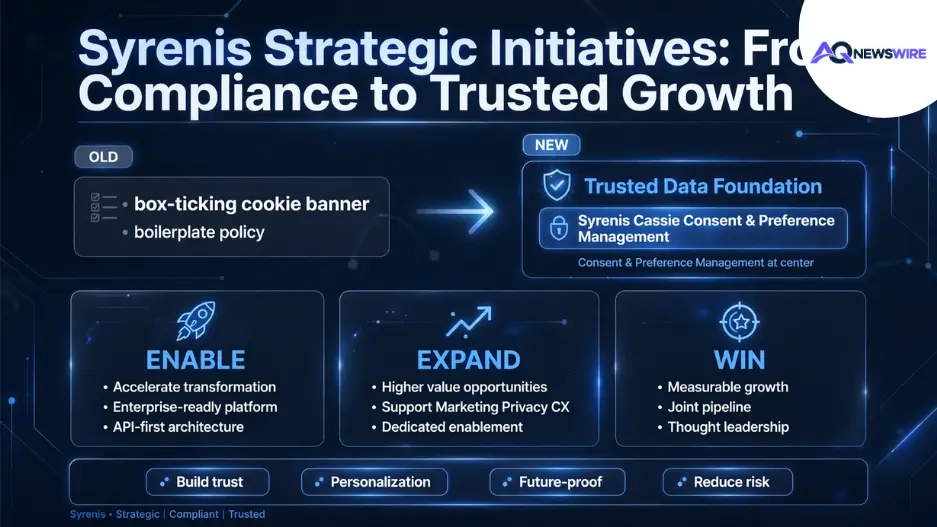
For years, corporate data privacy was treated like an annoying box-ticking exercise. Companies threw a cookie banner onto their homepage, linked a boilerplate privacy policy in the footer, and assumed their legal bases were covered under Europe’s GDPR or California’s CCPA.
That shortcut is no longer viable. Between a maze of new state-level privacy statutes in the United States, South America’s LGPD, strict regulatory investigations, and mounting consumer skepticism, surface-level compliance is breaking down. A popup banner that only blocks trackers inside a single browser tab does nothing to protect the rest of a company’s sprawling IT network.
At the center of this shift is Syrenis, an enterprise consent and preference management company best known for its flagship platform, Cassie.
Rather than treating privacy as a coat of paint on a website, Syrenis has launched a series of strategic initiatives that rethink how user consent moves through an organization. By handling individual permissions as live, auditable records connected straight into central databases, Syrenis is helping major enterprises turn complicated legal burdens into a competitive advantage.
1. The Technological Core: The Cassie Platform Roadmap
The real engine behind Syrenis’ growth is its focus on structural decoupling. Traditional consent widgets simply sit in the browser, intercepting tags and cookies. The issue? None of those choices automatically sync back to internal business systems like CRMs, marketing clouds, or ERP databases.
Building from the Back End: The API-First Model
Syrenis designed Cassie from the server outward. Its main engineering priority has been establishing a robust API-first framework.
Instead of letting a web browser dictate the single source of truth, Cassie acts as a central switchboard. Whenever an individual updates their contact preferences, opts out of automated profiling, or changes their communication channels, that decision is captured instantly. From there, bi-directional REST APIs and webhooks push the update across every connected sales, analytics, and marketing tool simultaneously.
High-Throughput Processing Without Lag
If a consent system slows down page load times by even half a second, e-commerce conversion rates drop and search rankings suffer. Global brands process tens of millions of digital interactions each week, making real-time validation a massive technical hurdle.
Syrenis tackled this by building a cloud-native engine optimized for high-volume throughput and sub-second latency. When a user lands on a site or opens an app, their specific privacy rules are resolved in milliseconds. Brands can serve personalized content without worrying about accidentally triggering unauthorized tracking scripts.
Cross-Device Identity Stitching
Few consumers stick to a single screen. Someone might read an article on an iPhone app, browse products from a laptop browser, make a purchase at a brick-and-mortar register, and later call customer support.
A key pillar of Syrenis’ roadmap is deterministic identity resolution. By securely linking verified account details—such as hashed email addresses, loyalty program IDs, or CRM profiles—to a unified consent record, Cassie eliminates channel disconnects. If someone opts out of phone marketing in their online account settings, customer support agents see that restriction immediately.
2. Expanding into Highly Regulated Industries
While small companies often rely on basic, out-of-the-box consent tools, Syrenis directs its business strategy toward sectors dealing with extreme regulatory scrutiny and heavy legal consequences.
Healthcare & Life Sciences
Medical networks and pharmaceutical firms walk a tightrope between digital analytics and strict patient privacy rules like HIPAA and international health data standards. Syrenis adapted its deployment models for clinical trials, research databases, and patient portals. This allows healthcare systems to collect specific research consent while keeping clinical audit records strictly isolated and legally sound.
Financial Services & Banking
In modern open-banking systems, financial institutions have to document transaction-level permission before sharing financial details with third-party apps or payment platforms. Syrenis has targeted this market by embedding verifiable consent workflows directly into account onboarding systems, mobile banking apps, and wealth-management tools.
Global Direct-to-Consumer Retail
For multinational e-commerce brands, juggling country-specific rules can wreck checkout conversion rates. Syrenis expanded its multi-lingual, geolocation-aware capabilities so the system adapts automatically. A shopper visiting from Germany sees a strict opt-in model under GDPR rules, while a visitor from Texas gets an opt-out framework that matches local state law—all running through one single backend.
3. The Move to Zero-Party Data and Deeper Integrations
With third-party tracking cookies quickly disappearing and mobile operating systems making tracking opt-in by default, digital marketers are facing an identity blind spot. Companies can no longer buy passive consumer behavioral trails; they need to ask customers directly for their preferences.
Syrenis built its Zero-Party Data strategy around this reality:
Self-Service Preference Dashboards: Instead of asking users to make an aggressive "all or nothing" choice on a homepage banner, Syrenis gives them granular control. Customers can choose exactly what topics interest them, how often they want to hear from a brand, and whether they prefer email, SMS, or app notifications.
Pre-Built Enterprise Connectors: Consent is useless if it sits in an isolated silo. Syrenis keeps expanding out-of-the-box connectors for core platforms like Salesforce, Microsoft Dynamics, SAP, Adobe Experience Platform, and Snowflake.
Cutting Down Unsubscribe Rates: When people only have one option—clicking a permanent unsubscribe link—brands lose access to valuable customers. Offering granular options allows people to dial back communication frequency instead of walking away completely, saving valuable marketing lists.
4. Compliance by Design: Verifiable Audits and User Rights
When a regulatory agency opens an investigation, officials never ask whether a company currently has a banner on its website. They demand historical proof: Show us exactly what privacy terms User X saw, what box they checked, and the timestamp from three years ago.
Syrenis answers this with a strict focus on audit readiness.
Tamper-Evident Historical Records: Every consent action captured in Cassie creates an unalterable log. It stores the date, the exact policy version shown at that moment, and the customer's selection. If an audit or legal inquiry comes up, the company has an immediate, verifiable paper trail.
Automating Data Subject Access Requests (DSAR): Laws like the GDPR give people the legal right to ask for their personal data or demand its total deletion. Fulfilling these requests by hand across dozens of databases takes legal and IT teams weeks. Syrenis automates this flow, verifying identities and automatically coordinating records cleanup across every linked system.
5. Emerging R&D: Artificial Intelligence and Data Governance
As companies race to plug customer data into predictive models and internal generative AI tools, data governance is entering uncharted territory.
Syrenis is focusing its research and development on AI Governance and Algorithmic Consent Lineage:
Training Data Permissions: If a company trains an internal AI model on customer interactions, it must prove it has direct legal authorization to use that information for machine learning. Syrenis is working on lineage tracking that links original customer consent directly to internal AI training pipelines.
Upstream Filtering for AI: Deleting a record from an everyday SQL database is easy. Removing a customer's influence from a machine learning model that has already finished training is mathematically complex and expensive. Syrenis prevents this headache by filtering data before it ever hits vector databases or training pools, ensuring unconsented data never gets ingested in the first place.
Designing Smarter Privacy Interfaces: "Consent fatigue" is real. Users blindly click away banners just to read a page. Syrenis is researching how different layout options and clear language affect user decisions, helping companies build honest interfaces that respect user choices without creating friction.
Strategic Pillars vs. Enterprise Outcomes
| Strategic Pillar | Core Focus Area | Concrete Business Value |
| API-First Architecture | Bi-directional data synchronization via REST APIs | Removes internal silos and unifies permissions across older databases and modern cloud stacks. |
| High-Throughput Ingestion | Low-latency cloud infrastructure | Keeps sites fast and protects checkout conversions during heavy global traffic spikes. |
| Identity Resolution | Cross-device deterministic preference mapping | Applies user choices across mobile apps, websites, physical stores, and support centers. |
| Zero-Party Data Capture | Granular, self-service preference portals | Reduces full unsubscribes by collecting declared customer interests directly. |
| Audit Defense Engine | Immutable historical logging and policy version tracking | Delivers clean, time-stamped proof for regulators during legal or compliance reviews. |
| AI Data Governance | Upstream algorithmic consent verification | Protects proprietary AI and machine learning projects from non-compliant training data. |
Moving from Defense to Growth
For a long time, executive teams viewed data privacy solely as an insurance policy—a cost center designed to avoid getting hit with massive regulatory fines.
Syrenis’ strategic roadmap reflects a much smarter approach. By building around decoupled systems, fast data flow, transparent customer dashboards, and rock-solid audit trails, they have elevated consent into a core business asset.
As privacy rules tighten and people become more protective of their digital footprints, organizations with unified, honest consent systems will not just stay out of legal trouble. They will earn the one thing modern digital marketing desperately needs: lasting customer trust.
Frequently Asked Questions
What is Syrenis, and what is its primary platform?
Syrenis is an enterprise software company specializing in data privacy and consent management. Its flagship platform is Cassie, a comprehensive consent and preference management system (CMP) that tracks, syncs, and manages consumer data permissions across complex business networks.
How is Cassie different from typical website cookie banners?
Most cookie plugins only work inside the web browser to block superficial tracking tags. Cassie is a full, API-first system that connects straight into backend databases, CRMs, marketing platforms, and customer data platforms, making sure consent updates apply everywhere across a company.
What are Syrenis’ main strategic priorities right now?
The company is focused on deep API-first integrations, millisecond-fast data processing, deterministic cross-device tracking, self-service zero-party preference centers, and new governance tools for data used in enterprise AI models.
What privacy laws does Syrenis support?
The platform supports compliance across every major international and regional privacy regulation, including the EU’s GDPR, California’s CCPA/CPRA, Brazil’s LGPD, Canada’s PIPEDA, and the expanding wave of US state-level privacy mandates.
Why does an API-first design matter for privacy?
An API-first approach ensures that privacy choices are treated as live data records rather than disposable browser cookies. It allows enterprise software to share updates instantly, preventing marketing teams from accidentally reaching out to an unsubscribed customer.
How does Syrenis support zero-party data strategies?
As traditional third-party tracking disappears, Syrenis gives companies preference centers where customers can state their interests, preferred channels, and contact frequencies directly, creating reliable, fully consented first-party profiles.
How does Syrenis help heavily regulated sectors like finance and healthcare?
Syrenis provides strict data separation, role-based security permissions, and unchangeable audit records that meet the tough legal standards of HIPAA, open-banking requirements, and clinical research protocols.
What is an immutable audit trail in privacy management?
It is a tamper-evident, time-stamped record that shows the exact date, policy version, interface, and choice a user selected when granting permission, giving companies clear evidence during regulatory reviews.
How does Cassie handle Data Subject Access Requests (DSARs)?
Cassie simplifies the entire DSAR process by verifying who is making the request, tracking regulatory deadlines, and coordinating the automated retrieval or deletion of records across all connected internal systems.
What is Syrenis doing in the enterprise AI space?
Syrenis is building tools to track data lineage and user permission before customer information is fed into machine learning models, ensuring companies do not accidentally train AI systems on unconsented personal data.
You may also like to read:
Charfen.co.uk Explained | What It Is? Content Categories, and User Guide