
Pop culture has a habit of reducing fascinating people to trivial footnotes. Mention the name Carlos Scola Pliego, and for most music fans and casual readers, only one detail registers: he was once married to British-Nigerian music icon Sade Adu.
When their relationship surfaced in the late 1980s, the international entertainment press couldn't get enough of them. Sade was an elusive, elegant superstar at the height of her global reach, and the sudden news that she had married an enigmatic Spanish filmmaker in an old castle outside Madrid set off an absolute media frenzy.
Yet long before and long after that high-profile marriage, Carlos Scola Pliego was living a grounded, purposeful life built around visual storytelling. He was neither an aspiring celebrity nor a red-carpet regular. Instead, he was a technical, disciplined filmmaker who dedicated his professional life to the intricate machinery of European movie sets.
To really understand Carlos Scola Pliego, you have to look past the tabloid headlines and appreciate the man himself: his creative upbringing in Spain, his contributions behind the lens on major international films, the realities of his whirlwind romance, and the deliberate peace he chose once the dust settled.
Early Life and Creative Roots in Spain
Carlos Scola Pliego was born and raised in Spain, coming of age during one of the most culturally vibrant eras in the nation’s modern history. The late 1970s marked the end of the Franco dictatorship, ushering in a rapid artistic renaissance that swept across Madrid and Barcelona.
For young creatives at the time, the air was electric. Known widely as La Movida Madrileña, this countercultural movement sparked fresh experimentation in rock music, visual art, street fashion, and auteur cinema. Directors like Pedro Almodóvar and Fernando Colomo were redefining what Spanish stories could look like on screen.
Growing up in this shifting landscape, Scola Pliego found himself drawn toward moving pictures. But unlike many peers who dreamed of acting or holding a megaphone in front of a cheering crowd, he was fascinated by how movies actually get put together from the ground up. He enrolled in film studies, spent time on independent sets, and chose to learn the trade through some of the most demanding, unglamorous roles in the industry.
He began his career in the late 1970s as a script supervisor—often known as a continuity supervisor on European productions. If you ask any veteran director, they will tell you that a script supervisor is the unsung backbone of any production. The job requires an eagle eye: tracking camera positions, catching tiny differences in actor gestures across dozens of takes, noting script alterations on the fly, and ensuring that editors have seamless footage to cut together in post-production.
Scola Pliego tackled early Spanish titles like La boda del señor cura in 1979 and Fernando Colomo's comedic hit Ópera prima in 1980. Those early years taught him patience, logistical rigor, and an appreciation for visual rhythm that would define the rest of his career.
A Career Behind the Camera: From Spanish Sets to Global Studios
By the early 1980s, Spain had established itself as a prime European destination for international co-productions. Foreign studios loved the country's reliable weather, varied landscapes, and talented local crews. Scola Pliego’s sharp eye and fluent communication skills made him an obvious candidate to step into the assistant directing department on larger projects.
Working on International Productions
As an assistant director, your focus shifts from continuity details to the immense practical engine of the set. You are responsible for scheduling shoot days, wrangling background actors, keeping department heads in sync, and solving real-world crises before the director even notices them.
During this decade, Scola Pliego contributed to notable international productions filming across Spain:
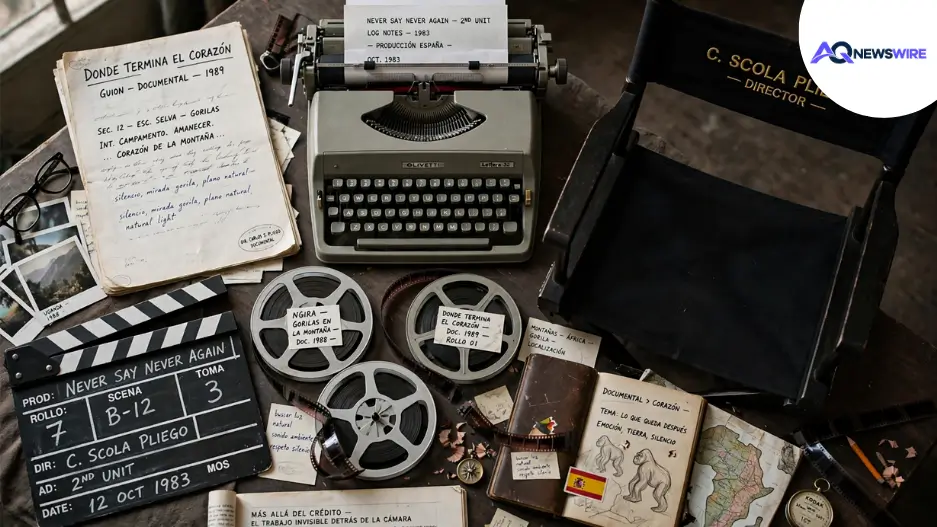
Never Say Never Again (1983): In this high-profile return of Sean Connery as James Bond, Scola Pliego served on the Spanish second unit directing crew, managing logistics for action sequences on location.
Curse of the Pink Panther (1983): Directed by Hollywood veteran Blake Edwards, this production relied on local crew members like Scola Pliego to handle European location setups and complex comedic timing.
Eleni (1985): A somber historical drama directed by Peter Yates and starring John Malkovich, demanding period accuracy and coordinated crowd management.
Working across multiple languages and distinct production cultures proved Scola Pliego's versatility. He earned a reputation among European line producers as a calm, dependable technician who kept stressful sets running smoothly.
Finding His Own Voice in Documentaries
Big studio films paid the bills, but documentary storytelling was where Scola Pliego explored his own artistic voice. He cared deeply about the natural world, human communities, and environmental conservation.
In 1988, he co-directed and wrote Ngira: Gorilas en la montaña, a documentary short exploring mountain gorilla habitats and the local communities living alongside them. A year later, he directed and penned Donde termina el corazón (1989). These independent projects showed an observant, gentle touch—far removed from the glossy commercialism of Hollywood sets.
The Marriage to Sade Adu: Romance Under the Spotlight
Toward the tail end of the 1980s, British singer Sade Adu was physically and emotionally exhausted. Her band’s first two records, Diamond Life and Promise, had catapulted her into a stratosphere of fame she never actively sought. The British press watched her every move, dissecting her style, her heritage, and her private life.
Looking for breathing room and creative peace, Sade stepped back and spent extended periods in Spain. That was where she crossed paths with Carlos Scola Pliego.
A Quiet Connection in Madrid
Their meeting was completely natural. Introduced through mutual creative acquaintances in Madrid's arts scene, the attraction between them made immediate sense.
Carlos wasn't in awe of her celebrity. He understood creative pressure, loved visual art, and lived a private, authentic life. For Sade, who was still grieving the loss of her father and struggling with the relentless noise of global stardom, Carlos offered warmth, quiet security, and a grounded partnership.
They shared a mutual appreciation for good food, architecture, classic cinema, and long evenings spent with close friends away from reporters. Sade leaned into life in Spain, improving her Spanish and embracing the slower, warmer pace of Madrid.
The 1989 Wedding
On October 11, 1989, Carlos Scola Pliego and Sade were married. The wedding took place at the historic Viñuelas Castle just outside Madrid.
True to their personal values, the ceremony was designed as an intimate, private gathering for their closest family and friends. Sade looked radiant in a Spanish-inspired bridal gown, and for a brief moment, the couple seemed to have created a sanctuary where international fame couldn't touch them.
The period of their marriage coincided with Sade's work on her landmark album Love Deluxe. The deep romanticism, quiet devotion, and emotional vulnerability that ran through tracks like "No Ordinary Love" and "Cherish the Day" unmistakably mirrored the passion, intensity, and domestic complexity of that era in her life.
Strains, Separation, and Divorce
Even the most genuine relationships can buckle under the weight of conflicting worlds. For Carlos and Sade, holding onto privacy while navigating the realities of global celebrity proved brutally difficult.
Why the Relationship Faltered
Several deep-seated tensions chipped away at the marriage over time:
The Invasive Media Lens: Carlos was a behind-the-scenes professional who cherished his anonymity. Suddenly having paparazzi camped outside their residence in Madrid took a heavy psychological toll.
Conflicting Geographies: Sade’s music career required regular travel to London recording studios, American concert venues, and global promotional tours. Carlos was an active filmmaker whose projects and network were tied directly to mainland Spain.
Differing Realities: Navigating the lifestyle demands of an internationally touring pop superstar alongside a working European film professional created natural emotional distance.
By the early 1990s, the strain became too much to sustain. The couple separated, and their divorce was finalized in 1995.
In the rare interviews where Sade touched on the split years later, she spoke with heartfelt honesty. She never vilified Carlos; instead, she described the profound sadness of watching a real, meaningful love unravel under the pressures of circumstances they couldn't control. They had no children together during their marriage.
Where Is Carlos Scola Pliego Today?
In an era where celebrity exes routinely write tell-all memoirs, launch podcasts, or build social media followings off their past relationships, Carlos Scola Pliego did something rare: he chose total privacy.
Once the divorce was final, he walked completely away from the international spotlight. He gave no sit-down interviews, sold no private photographs, and refused to capitalize on his former marriage in any way. Instead, he returned to Spain and resumed his quiet, steady work in European film and television production.
Over the following decades, he continued collaborating on independent film projects, advising on technical crews, and helping younger filmmakers find their footing. Production records show his steady involvement across the Spanish film landscape, including contributions to international productions like Goal II: Living the Dream in 2007.
Today, Carlos lives comfortably and quietly in Spain. He maintains no public social media presence and lives entirely on his own terms. That silence isn't a sign of bitterness; it is the natural lifestyle of a man who was always an artisan at heart.
Frequently Asked Questions
Who is Carlos Scola Pliego?
Carlos Scola Pliego is a Spanish filmmaker, assistant director, and writer. He built a respected career working behind the camera on Spanish and international film productions and became globally known through his marriage to singer Sade Adu.
When did Carlos Scola Pliego and Sade get married?
Carlos Scola Pliego and Sade Adu were married on October 11, 1989. Their wedding was a private ceremony held at the historic Viñuelas Castle near Madrid, Spain.
How long were Carlos Scola Pliego and Sade together?
Their marriage lasted six years, from their wedding in October 1989 until their divorce was officially finalized in 1995.
Did Carlos Scola Pliego have children with Sade?
No, Carlos and Sade did not have any children together during their marriage. Sade later gave birth to her only child in 1996 with Jamaican music producer Bob Morgan.
What major films did Carlos Scola Pliego work on?
His credits include serving as an assistant director on the James Bond film Never Say Never Again (1983), Blake Edwards's Curse of the Pink Panther (1983), and Peter Yates's drama Eleni (1985). He also directed documentary shorts such as Ngira: Gorilas en la montaña (1988).
How did Carlos Scola Pliego meet Sade?
They met in Madrid in the late 1980s through mutual acquaintances in the Spanish arts and film community while Sade was spending time in Spain to rest between major album cycles.
Why did Carlos Scola Pliego and Sade divorce?
Their marriage dissolved due to the constant pressure of international fame, relentless media scrutiny, long periods apart caused by touring schedules, and the difficulty of balancing two demanding creative careers across different countries.
What was Carlos Scola Pliego’s first job in the film industry?
He started in the late 1970s working as a script supervisor on classic Spanish comedy and drama films, including La boda del señor cura (1979) and Ópera prima (1980).
Does Carlos Scola Pliego have public social media accounts?
No, Carlos Scola Pliego does not have any verified or active public accounts on platforms like Instagram, X, or LinkedIn, intentionally prioritizing his personal privacy.
Where does Carlos Scola Pliego live now?
He resides in Spain, where he continues to live a quiet life out of the public eye.