
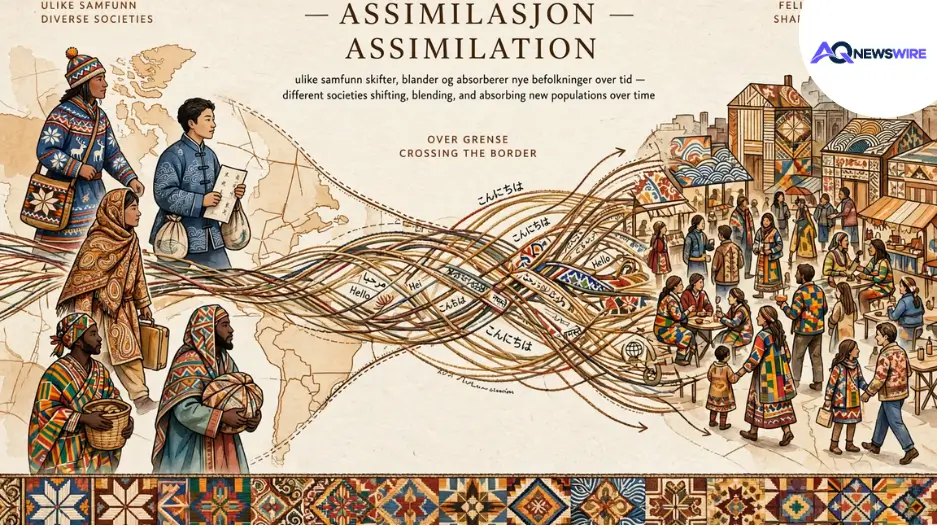
Have you ever wondered how different societies shift, blend, and absorb new populations over time? It’s one of the most fascinating questions in history and sociology. When people move across borders—or when distinct cultures find themselves living side by side—a massive social transformation kicks into gear. At the center of this dynamic is assimilation (often spelled assimilasjon if you're looking at Nordic or European policy papers).
Let's be clear: assimilation isn't a simple, black-and-white checkbox. It's a complex, multi-layered journey that has built nations, disrupted indigenous landscapes, and sparked endless debates among modern sociologists. Let’s break down what it actually means, how the theory has evolved, and why today's conversations look a whole lot different than they did a century ago.
Defining Assimilation: Core Concepts and Terminology
In plain sociological terms, assimilation is the process where individuals or minority groups adopt the cultural norms, values, behaviors, and languages of a dominant host society. Over time, distinct cultural lines begin to blur as groups blend into the larger social fabric.
Of course, sociologists love to break big ideas down into smaller pieces to see how they actually work on the ground:
The Key Dimensions
Cultural (Behavioral) Assimilation: This is usually the first thing you notice. It’s when newcomers pick up the local language, start wearing similar clothes, adopt everyday habits, and lean into local social customs.
Structural Assimilation: This goes deeper than surface-level customs. It happens when minority groups actually break into the primary social circles, local clubs, institutional networks, and professional organizations of the host society on equal footing.
Marital Assimilation (Amalgamation): Often viewed as the deepest level of social blending, this involves high rates of intermarriage across generations, creating a shared biological and cultural lineage.
Voluntary vs. Involuntary Assimilation
Here’s a crucial distinction: was it a choice, or was it forced?
Voluntary assimilation happens naturally when individuals choose to adopt host cultural patterns to make life easier, secure better jobs, or fit in smoothly.
Involuntary (or forced) assimilation is a dark chapter in history. It occurs when governments or dominant powers systematically ban minority languages and traditions, forcing people to abandon their heritage under threat or duress.
How the Theory Evolved Over Time
Our take on cultural blending has changed drastically over the last hundred years. Early sociologists used to look at the process through a very rigid lens.
The Old-School Assimilation Model
Back in the early 20th century, theorists like Robert E. Park introduced the idea of a "race relations cycle." The core assumption was simple: different groups inevitably followed a straight, predictable path from initial contact to competition, accommodation, and finally, total assimilation. The underlying belief was that cultural differences would just naturally wash away over time.
The "Melting Pot" Metaphor
During the height of industrial immigration, countries like the United States leaned hard into the "melting pot" idea. The dream was that diverse cultural ingredients would melt together in a giant crucible, fusing into a brand-new, unified national identity. It sounded poetic, but in practice, it often put heavy pressure on minorities to strip away their ancestral roots just to fit the mold.
The Shift Toward Pluralism
As the world confronted historical injustices—like the devastating forced assimilation policies inflicted on Indigenous populations globally—the classical model took a beating. Societies finally realized that demanding total cultural erasure was neither ethical nor realistic. That realization opened the door to modern multicultural frameworks that value pluralism right alongside shared civic values.
Modern Debates: Assimilation vs. Integration
If you look at contemporary policy discussions—especially across Europe and the Nordic regions—the conversation has largely pivoted away from forced conformity and toward active integration.
Assimilation vs. Integration
Assimilation traditionally implies a one-way street: the newcomer adapts entirely to the host culture, usually leaving their old identity at the door.
Integration, on the other hand, is viewed as a two-way street. The goal is to make sure immigrants achieve full economic and social participation—good jobs, stable housing, solid education—while still giving them the freedom to practice their religion, speak their native language at home, and honor their cultural traditions.
The European and Nordic Perspective
Countries managing high immigration rates constantly wrestle with how to balance national unity with minority rights. Language classes and civic education are treated as vital tools for independence, but modern planners are careful to separate required civic participation from oppressive cultural assimilation.
The Friction Points
Tensions still bubble up around a few core issues:
Identity vs. Belonging: Immigrants often feel caught in the middle, trying to honor where they came from while figuring out how to fit in where they are.
Systemic Barriers: Structural racism and economic inequality can completely stall structural assimilation, leaving communities marginalized no matter how much they adapt culturally.
Preserving Heritage: Indigenous groups fiercely protect their languages and customs against the homogenizing steamroller of modern globalization.
Frequently Asked Questions (FAQ)
What's the main difference between assimilation and integration?
Assimilation usually means adopting the dominant culture until your original cultural traits fade away. Integration lets you participate fully in society economically and socially while keeping your unique cultural identity alive.
Is assimilation always a choice?
Not at all. While plenty of people choose to blend in to make life easier, history is full of ugly examples of forced, state-mandated assimilation targeting Indigenous populations.
What does "structural assimilation" actually mean?
It’s the stage where minority groups break into the actual institutions, economic networks, and close social circles of the host society as true equals.
Why is language so important in cultural assimilation?
Picking up the dominant local language is almost always the key catalyst that opens the door to better education, jobs, and broader social acceptance.
What does assimilasjon mean in Nordic countries?
It means the exact same sociological process of cultural and social blending, frequently debated across Scandinavia regarding immigration policies and the history of Indigenous groups like the Sami.
Can cultural exchange go both ways?
Sociologists generally view general cultural borrowing as a two-way street, but strict "assimilation" specifically refers to minority groups adopting the dominant framework.
Why do people criticize the "melting pot" idea today?
Critics point out that the melting pot metaphor demands uniformity, subtly pressuring people to erase their heritage instead of embracing diversity.
What is cultural pluralism?
It’s a setup where smaller groups inside a larger society get to keep their unique cultural identities, and the wider public actually respects and accepts those differences.
Is complete assimilation realistic in today's globalized world?
Hardly. With instant digital connections, global travel, and diaspora communities staying in close touch with their homelands, total cultural erasure is pretty rare these days.
How do modern governments help newcomers fit in?
Instead of forcing people to assimilate, most modern democracies focus on practical things: language training, anti-discrimination laws, equal job opportunities, and civic education.
You may also like to read: