

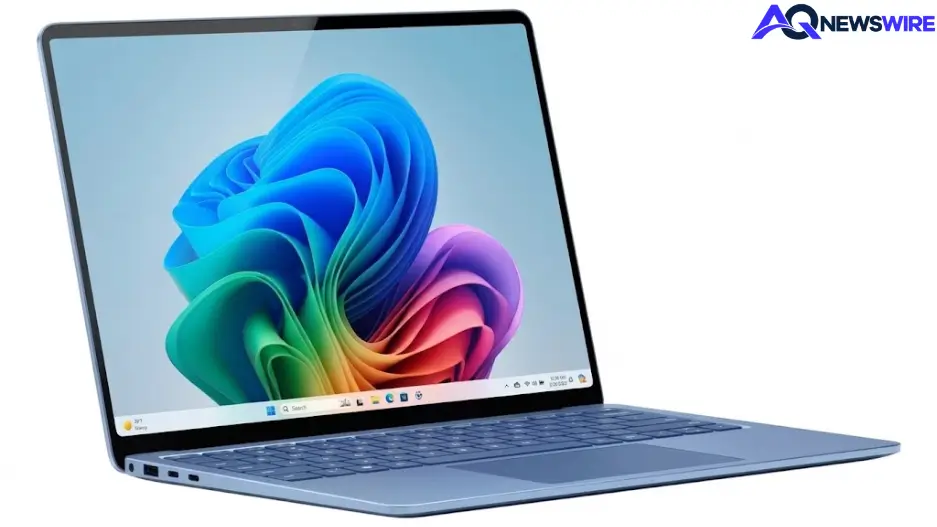
For years, anyone doing serious creative work, heavy video rendering, or machine learning faced a predictable dilemma when shopping for a portable machine. You either bought a MacBook Pro for its battery life and unified memory, or you bought a bulky Windows gaming laptop with jet-engine fans and a battery that died before lunch.
Microsoft and Nvidia are trying to end that trade-off once and for all.
At an event in San Francisco, Microsoft officially opened preorders for the Surface Laptop Ultra, and it comes with an eye-watering starting price: $2,599. Rather than relying on standard laptop silicon, Microsoft teamed up directly with Jensen Huang’s team to build the machine around Nvidia’s brand-new "RTX Spark" superchip—an Arm-based processor paired with heavy-duty Blackwell graphics architecture.
The price tag will give casual shoppers sticker shock, but this isn't built for sending emails or running Excel sheets. Microsoft is taking aim at the one demographic Apple has owned uncontested for a decade: high-end developers, creative professionals, and engineers willing to pay top dollar to carry workstation power in their backpack.
Supercomputing in a 4.5-Pound Shell
To understand why this laptop costs as much as a used car, look at what’s under the hood.
Over the past year, the PC market has been flooded with "Copilot+ PCs"—thin, snappy notebooks built on Qualcomm or Intel chips that handle basic tasks like blurring webcam backgrounds or live-translating audio. Those built-in neural processors top out around 40 to 50 TOPS (trillion operations per second).
The Surface Laptop Ultra is an entirely different beast.
By combining an 18- or 20-core Grace Arm CPU with a dedicated Blackwell RTX GPU, the RTX Spark superchip pumps out up to a petaflop of AI compute. Jensen Huang pointed out during the unveiling that this single 4.5-pound notebook matches the raw processing muscle of Nvidia’s legendary DGX-1 data center rack from 2016.
Crucially, the CPU and GPU share a massive unified memory architecture—starting at 24GB on the base model and scaling all the way up to an absurd 128GB of RAM on the high-end $5,899 configuration.
That unified memory pool solves a massive headache for AI researchers and developers: running hefty 70-billion-parameter open-source models directly on local hardware without running out of video memory or needing an internet connection to ping a remote cloud server.
The Apple Playbook, Built for Windows
The hardware itself feels like Microsoft took the best parts of Apple’s MacBook Pro design and gave it a Windows twist.
The Ultra features a 15-inch, 120Hz mini-LED PixelSense touchscreen that cranks up to 2,000 nits of peak brightness. Microsoft also gave it a MagSafe-style breakaway magnetic USB-C charging port, alongside a full-size SD card slot, HDMI 2.1, and an oversized haptic trackpad.
Yet the real weapon Microsoft is counting on to pull creators away from Cupertino isn't screen brightness—it's Nvidia’s software moat:
Native CUDA Support: The vast majority of modern AI development, PyTorch libraries, and machine-learning frameworks were built natively around Nvidia's CUDA architecture. While Apple's M-series chips are fast, translating CUDA-dependent code onto Mac silicon often requires messy workarounds. The Ultra runs it natively on bare metal.
Consistent Battery Performance: Because the chip uses an Arm-based design, Microsoft claims the machine keeps more than 99% of its full performance even when unplugged from the wall—fixing one of the oldest gripes about Windows mobile workstations.
The Cloud Exit Strategy
Beyond hardware specs, the machine signals a big shift in how tech giants talk about artificial intelligence.
Microsoft has poured tens of billions of dollars into Azure data centers to run cloud AI queries. But corporate clients have started balking at recurring monthly API fees, bandwidth lag, and the legal risks of uploading sensitive intellectual property and proprietary code to someone else's server.
Packing serious Nvidia horsepower straight onto an engineer’s desk cuts through that friction. Code stays on the machine, models respond instantly, and companies stop paying per-token subscription bills every time their developers test a feature.
A High-Stakes Gamble
There's no sugarcoating the price: asking corporate buyers and freelancers to drop at least $2,600—and nearly $6,000 for top-tier memory—is a massive ask in an uncertain economy.
When shipping starts on October 16, Microsoft won't be competing with budget Windows PCs. It will be walking straight onto Apple's home turf. But if the RTX Spark delivers on its promise of desktop-grade AI compute without killing the battery, Windows power users finally have a flagship machine with zero compromises.



