

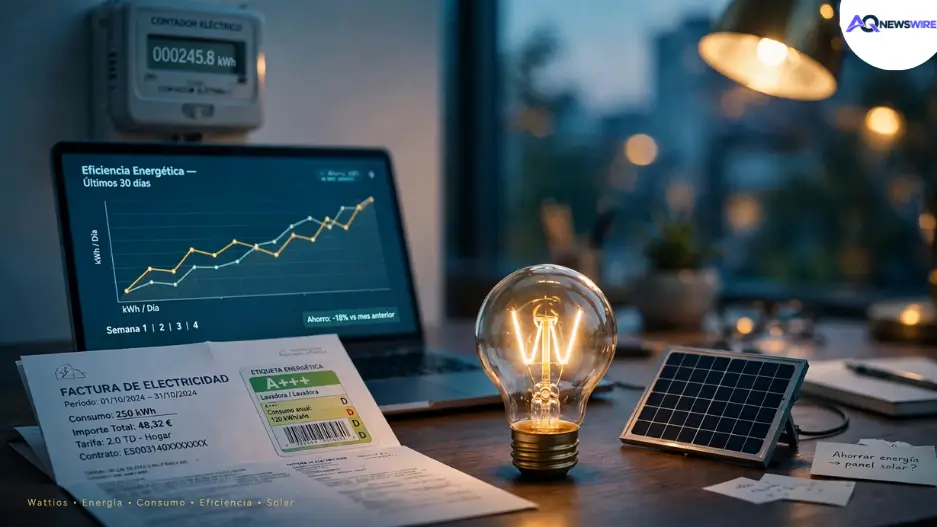
When reading an electricity bill, checking a household appliance label, or researching solar panel systems, you inevitably encounter terms related to electrical power. Among the most foundational of these terms is the watt (frequently referred to as vatio or wattio in Spanish-language contexts).
Understanding what "wattios" represent goes far beyond a simple physics definition. It forms the core of how we consume energy, calculate utility costs, and evaluate the efficiency of modern electronics, home appliances, and renewable energy installations.
What Is a Wattio (Watt)? Definition and Core Concept
At its core, a watt (wattio) is the standard International System of Units (SI) measurement for power. Named after James Watt—the 18th-century Scottish inventor whose improvements to the steam engine helped drive the Industrial Revolution—a watt measures the rate at which electrical energy is generated, transferred, or consumed.
The Scientific Formula: Scientifically, one watt is equivalent to one joule of energy transferred per second ($1 \text{ W} = 1 \text{ J/s}$).
The Electrical Relationship: In electrical circuits, power is the product of electrical pressure (volts) and current flow (amps). Mathematically, this is expressed as:
$$\text{Watts} = \text{Volts} \times \text{Amps}$$
Put simply, if volts represent the pressure pushing electricity through a wire and amps measure the volume of current flowing, wattios measure the resulting work being done at any exact moment.
Watts vs. Watt-Hours: Power Versus Energy
A common point of confusion for consumers is mixing up instantaneous power with total energy consumption. To master energy management, it helps to separate these two concepts:
Watts (Wattios - Power): The rate at which an appliance uses energy right now. Think of this like the speed at which a car is driving (miles per hour).
Watt-Hours (Wh / kWh - Energy): The total amount of energy consumed over a given period of time. This is equivalent to the total distance traveled by that car.
A Quick Practical Example
A standard LED lightbulb might draw 10 watts of power when switched on.
If you leave that bulb burning for 1 hour, it consumes 10 watt-hours of energy.
If you run a heavy-duty home heater rated at 2,000 watts (2 kilowatts) for just 30 minutes, it consumes 1,000 watt-hours (1 kilowatt-hour or 1 kWh) of energy.
Utility companies bill customers based on kilowatt-hours (kWh)—the total volume of energy consumed over a billing cycle.
Scaling the Units: From Milliwatts to Megawatts
Because electrical systems vary drastically in scale—from tiny smartphone microchips to massive industrial power plants—the standard wattio uses metric prefixes to scale up or down:
Unit NameSymbolEquivalent ValueCommon ApplicationMilliwattmW1/1,000 of a wattMedical sensors, Bluetooth microchipsWattWBase unit (1 W)LED lightbulbs, smartphone chargersKilowattkW1,000 wattsHousehold appliances (microwaves, hair dryers)MegawattMW1,000,000 wattsLarge data centers, commercial buildings, wind turbinesGigawattGW1,000,000,000 wattsRegional power grids, major utility plants
How Wattios Dictate Household and Industrial Energy Use
Knowing how to interpret the wattage ratings on devices allows you to take control of home efficiency and safety.
1. Appliance Power Draw Comparison
Different home systems demand vastly different quantities of wattios to operate:
LED Light Bulb: 8W – 15W
Laptop Charger: 45W – 90W
Refrigerators: 200W – 400W (running average)
Washing Machines: 500W – 2,200W
Electric Space Heater / Oven: 1,500W – 3,000W
2. Preventing Circuit Overloads
Understanding the relationship between watts, volts, and amps ensures you do not overload residential circuit breakers. Standard home circuits in many regions operate at roughly 230V or 120V and are typically rated for 15 or 20 amps. Plugging too many high-wattage devices (like heaters and kettles) into a single multi-plug extension draws excessive current (amps), tripping the safety breaker.
Renewable Energy and Solar Power Applications
The term wattios takes center stage when evaluating solar photovoltaic (PV) systems and portable power stations.
Peak Power (Wp - Watts-peak): Solar panels are rated by their peak wattage under ideal laboratory test conditions. A 400W solar panel is capable of producing 400 watts of direct current (DC) power under optimal sunlight angles.
Inverters and Battery Storage: Home battery systems are measured in terms of continuous power output (watts) and total storage capacity (watt-hours or kilowatt-hours). This dictates how many heavy household appliances you can run simultaneously during a grid outage.
Practical Takeaways for Energy Management
Look Beyond Brightness: When buying modern light bulbs, remember that watts measure power consumption, not illumination. Brightness is measured in lumens.
Calculate Running Costs: Multiply an appliance's wattage by the number of hours it runs daily to find its daily watt-hour footprint, helping you identify energy-hungry devices.
Optimize Efficiency: Replacing legacy incandescent bulbs or outdated appliances with lower-wattage, high-efficiency alternatives directly shrinks monthly utility overhead.
Frequently Asked Questions
What is a wattio (watt)?
A wattio or watt is the standard International System unit of measurement for electrical power, representing the rate at which energy is used, produced, or transferred.
How do watts differ from kilowatts?
A kilowatt is simply a larger metric multiple equal to 1,000 watts. It is commonly used to measure higher-draw appliances, solar arrays, and overall home energy usage.
What is the formula to calculate watts?
Watts are calculated by multiplying electrical voltage by current flow, expressed as the formula: $\text{Watts} = \text{Volts} \times \text{Amps}$.
Are watts the same thing as watt-hours?
No. Watts measure the instantaneous rate of power consumption at any exact moment, while watt-hours measure total energy consumed over a period of time.
Why does my utility bill measure energy in kWh?
Utility companies bill in kilowatt-hours (kWh) because it represents the cumulative volume of energy consumed across an entire billing cycle, rather than the momentary speed of power use.
How many watts equal one horsepower?
One mechanical horsepower is equivalent to approximately 746 watts of electrical or mechanical power output.
Do higher watts mean a brighter light bulb?
Not necessarily. In modern LED lighting, lumen output determines brightness, whereas wattage simply indicates how much electricity the bulb draws.
What appliances consume the most watts in a home?
Heating and cooling systems, electric water heaters, ovens, clothes dryers, and space heaters typically demand the highest wattage, often ranging from 1,500 to 4,500 watts.
What does Wp mean on a solar panel specification?
Wp stands for Watts-peak, indicating the maximum power output a solar panel can deliver under standard test conditions of direct sunlight.
How can I calculate how much running an appliance costs?
Multiply the device's wattage by the number of hours it runs to find total watt-hours, convert that to kilowatt-hours (divide by 1,000), and multiply by your local utility company's rate per kWh.