

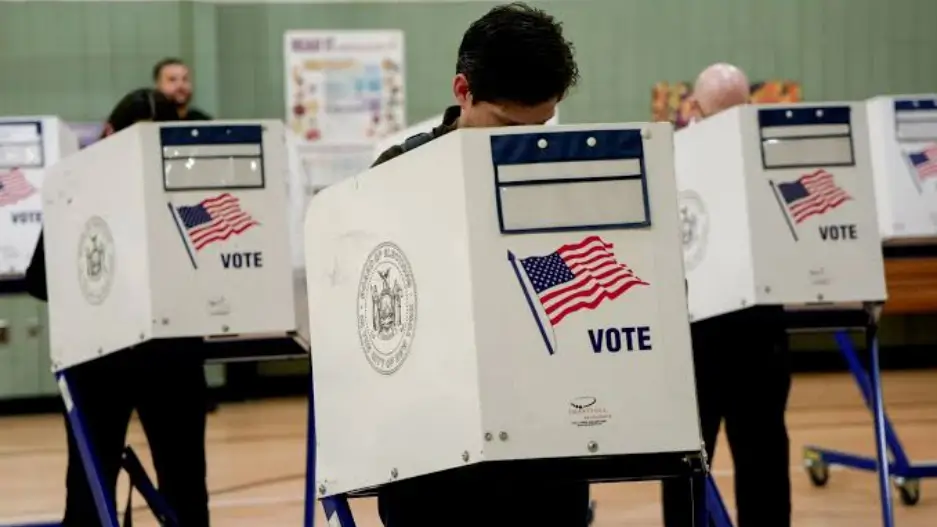
Every federal election cycle introduces political uncertainty to Wall Street, but midterm elections carry a specific structural weight for equity markets. While presidential races focus on broad macroeconomic visions and executive mandates, midterms dictate the mechanics of legislative execution: committee gavels, regulatory oversight budgets, statutory subsidies, and the pace of antitrust enforcement.
As voters determine the balance of power across both chambers of Congress, portfolio managers are not merely trading broad index beta. Instead, institutional capital is rotating into tactical sector allocations. The distribution of power on Capitol Hill will directly dictate the operational and regulatory reality for four foundational economic sectors: artificial intelligence, defense and aerospace, cryptocurrency and digital assets, and healthcare and biopharma.
Understanding the policy pathways in play reveals where market sentiment is overreacting, where real earnings risk resides, and how investors are positioning for post-election realities.
The Macro Backdrop: Gridlock as an Equity Asset
Before analyzing individual industry verticals, investors must weigh the broader historical relationship between midterm outcomes and capital market performance.
Historically, financial markets exhibit strong performance during periods of divided government. When opposing parties control the White House and at least one chamber of Congress, legislative throughput slows to a crawl. For equity markets, gridlock often serves as a natural volatility suppressor:
Tax Certainty: Divided control largely eliminates the threat of sweeping federal corporate income tax increases or punitive capital gains adjustments, providing CFOs with a stable planning horizon.
Deficit Constraints: Contentious budget debates limit broad-scale, unbudgeted fiscal stimulus packages, helping reduce upward pressure on benchmark Treasury yields.
Regulatory Moderation: Federal agencies still retain executive rule-making authority, but aggressive administrative overreach faces aggressive scrutiny through congressional subpoenas, committee oversight, and budget clawbacks.
While gridlock protects against broad macro disruption, it shifts the investment battleground directly to specific sectors whose forward earnings rely on government spending or regulatory clarity.
Artificial Intelligence: Subsidies, Grid Demands, and Oversight
Artificial intelligence has powered much of the equity market's multi-year rally, but the sector now faces growing scrutiny regarding capital expenditures, power grid absorption, and the return on invested capital for hyperscale infrastructure. The congressional balance of power introduces distinct catalysts for the AI ecosystem.
A Unified Majority Outlook
If one party consolidates control, expect accelerated legislative movement around federal artificial intelligence standards. A conservative-led legislature prioritizes domestic semiconductor independence, streamlined National Environmental Policy Act (NEPA) permitting for data center construction, and reduced friction around private enterprise AI deployments.
Under this framework, semiconductor fabrication foundries, domestic packaging providers, and commercial utility operators benefit from reduced friction when building out power infrastructure to meet hyperscale load demands.
A Divided Congress Outlook
Under split control, national AI policy will fracture along philosophical lines. Progressive lawmakers have already signaled heightened interest in antitrust scrutiny, algorithmic bias, data copyright protection, and the risks of a speculative technology bubble.
Legislative proposals questioning federal backstops or tax incentives for debt-heavy tech expansions could generate headline volatility for large-cap tech platforms. However, pure-play infrastructure vendors—companies manufacturing high-voltage transformers, cooling systems, and advanced networking silicon—will continue to derive pricing power from private hyperscale capex, which operates largely independent of Capitol Hill politics.
Defense and Aerospace: The Geopolitical Budget Imperative
Unlike tech or digital assets, the defense industry remains tethered directly to the annual congressional appropriations process. With ongoing regional conflicts, supply chain restocking demands, and structural military modernizations across the Pacific, defense spending serves as a baseline budget priority across both sides of the aisle.
Budget Baselines and Topline Expansion
Historically, a split or conservative-leaning Congress advocates for expanding topline National Defense Authorization Act (NDAA) baselines beyond administration budget requests. Traditional prime contractors benefit from multi-year procurement programs covering:
Precision-guided munitions and tactical air-defense interceptors.
Next-generation naval shipbuilding and undersea warfare platforms.
Autonomous defense tech, electronic warfare systems, and military space telemetry.
The Fiscal Friction Factor
The primary risk for defense stocks is not an ideological cut to military strength, but prolonged fiscal brinkmanship. When Congress fails to pass full appropriations bills and instead relies on stopgap Continuing Resolutions (CRs), the Pentagon cannot initiate new-start development programs or increase procurement rates on existing contracts.
Prime defense contractors operate on long-cycle deliveries with fixed-price development terms; protracted budget stalemates delay milestone payments, squeeze operational margins, and defer free cash flow conversion.
Cryptocurrency and Digital Assets: Regulatory Turf and Custody
Digital assets have transitioned from a retail-driven speculative asset into an institutional asset class shaped by exchange-traded products, institutional custody frameworks, and stablecoin payment rails. For crypto markets, the midterm election is viewed primarily as a referendum on regulatory oversight.
Jurisdictional Clarity: SEC vs. CFTC
The central legislative battle revolves around market structure legislation designed to draw clear boundaries between the Securities and Exchange Commission (SEC) and the Commodity Futures Trading Commission (CFTC).
Pro-Market Framework: A Congress favorable to digital asset integration is expected to advance clear market structure legislation, formally assigning primary spot market jurisdiction over non-security tokens to the CFTC while legitimizing dollar-backed stablecoin payment structures. This would create substantial tailwinds for institutional custodians, compliant public exchanges, and asset managers issuing tokenized real-world assets (RWAs).
Enforcement-First Approach: A split or consumer-protection-focused Congress increases friction around stablecoin yield structures, DeFi protocols, and decentralized banking integrations. Under this regime, regulatory policy remains anchored in judicial litigation rather than statutory clarity, potentially driving blockchain capital allocation toward overseas financial hubs.
Regardless of the headline outcome, institutional adoption of Bitcoin and Ether reserves by corporate treasuries and regulated asset managers has reduced systemic liquidation risk, keeping price discovery tethered to global liquidity and macroeconomic trends.
Healthcare and Pharmaceuticals: Pricing Pressure vs. Innovation
Healthcare accounts for roughly a fifth of the U.S. economy, making it a recurring target during electoral cycles. However, the sector is not a monolith; legislative outcomes create starkly divergent realities for pharmaceutical manufacturers, pharmacy benefit managers (PBMs), health insurers, and medical device makers.
Pharmaceutical Pricing and the IRA
Drugmakers continue to recalibrate clinical development pipelines around provisions of the Inflation Reduction Act (IRA), which empowered Medicare to directly negotiate pricing on high-expenditure prescription drugs.
A unified conservative Congress would likely seek to restrict further expansions of federal price-setting mechanisms, offering margin relief to large-cap biopharma firms with heavy exposure to oncology and metabolic therapies. Conversely, divided government leaves existing statutory price negotiation intact while preventing major new legislative overhauls.
Managed Care and PBM Scrutiny
Interestingly, the greatest immediate policy risk for the healthcare sector enjoys bipartisan momentum: regulatory reform targeting pharmacy benefit managers (PBMs). Lawmakers on both sides have criticized opaque drug-rebate arrangements and commercial spread pricing. Managed care organizations and vertically integrated health insurers face ongoing scrutiny, while medical device manufacturers and pure-play biotechnology research firms operate with relative insulation from direct legislative interference.
Key Scenarios: Mapping the Congressional Matrix
To build a resilient portfolio across election season, market participants evaluate four primary governance scenarios:
1. Unified Majority (Status Quo Maintenance)
Equity Impact: Broadly neutral-to-positive for corporate earnings.
Leading Sectors: Traditional energy, private defense primes, financial institutions, and domestic manufacturers.
Lagging Sectors: Heavily regulated renewable tech, companies reliant on discretionary consumer spending facing sticky baseline tariffs.
2. Divided Congress (House and Senate Split)
Equity Impact: Classically positive for broader equities due to structural gridlock.
Leading Sectors: Large-cap technology, defensive healthcare, high-cash-flow enterprise software.
Lagging Sectors: Heavily subsidized green energy initiatives, speculative assets dependent on broad fiscal intervention.
3. Congressional Turnover (Opposition Sweeps Both Chambers)
Equity Impact: Initial headline volatility followed by consolidation around defensive growth.
Leading Sectors: Pure-play medical devices, regulated utilities, domestic infrastructure.
Lagging Sectors: Large-cap AI platforms facing antitrust investigations, unregulated crypto payment frameworks.
Portfolio Strategy: How Investors Should Position
Election headlines routinely cause outsized short-term price discovery. However, long-term historical data reveals that broader macroeconomic fundamentals—interest rate paths, labor productivity, inflation trajectories, and corporate earnings growth—consistently outweigh election outcomes over multi-year horizons.
Smart positioning requires balancing near-term policy hedges with long-term thematic exposure:
Focus on Structural Secular Trends: AI infrastructure expansion, power grid upgrades, and defense restocking are multi-decade structural demands that proceed regardless of which party chairs congressional committees.
Avoid Binary Regulatory Wagers: Betting heavily on single-stock outcomes tied to specific regulatory approvals (e.g., specific cannabis reclassifications or isolated crypto banking bills) introduces uncompensated policy risk.
Exploit Headline Mispricings: Policy announcements often trigger knee-jerk sell-offs in fundamentally sound companies. When regulatory fears depress high-quality balance sheets with strong cash flow generation, these drawdowns provide disciplined entry points for patient capital.
Frequently Asked Questions
How do midterm elections typically impact the stock market?
Historically, equity markets experience elevated volatility in the months leading up to midterms due to policy uncertainty. Once election results are certified and political clarity is restored, stocks historically stage strong year-end and post-election rallies.
Why do markets generally favor a divided government?
Divided government results in political gridlock, which prevents either party from passing sweeping tax increases, radical regulatory shifts, or massive unbudgeted spending programs. This stability allows corporations to forecast earnings with greater certainty.
What is the primary midterm risk facing artificial intelligence stocks?
The primary risk centers on legislative oversight concerning antitrust concerns, algorithm transparency, and resistance to federal subsidies or backstops for heavily leveraged data center buildouts.
How does Congress affect the defense industry?
Congress controls the purse strings through the annual National Defense Authorization Act (NDAA) and defense appropriations. While total spending rarely drops, protracted budget stalemates and reliance on Continuing Resolutions can delay new contract awards and squeeze contractor margins.
Will the midterm election affect cryptocurrency regulations?
Yes. The balance of power determines whether Congress advances market structure legislation granting regulatory authority to the CFTC or preserves an enforcement-first framework led by the SEC.
Which healthcare segments are most vulnerable to election outcomes?
Pharmaceutical companies with high exposure to Medicare drug price negotiations and pharmacy benefit managers (PBMs) facing bipartisan transparency legislation carry the highest regulatory exposure.
Do midterm elections alter the Federal Reserve's monetary policy?
No. The Federal Reserve operates as an independent central bank. Interest rate decisions and balance sheet adjustments are guided by dual-mandate metrics (inflation and employment data) rather than political cycles.
Are clean energy and renewable stocks heavily impacted by the midterms?
Yes. Clean energy stocks are sensitive to congressional control because tax credits, loan guarantees, and infrastructure grants face review, reallocation, or clawback attempts depending on legislative leadership.
How should individual investors manage election volatility?
Rather than trying to time political outcomes, investors should focus on companies with pricing power, sustainable free cash flow, and low reliance on government subsidies. Diversification across defensive and growth assets remains the best hedge against political headline risk.
Can a contested election disrupt financial markets?
Yes. Prolonged ballot recounts, legal challenges, and delays in certifying congressional majorities can extend market volatility and elevate risk premiums until leadership is definitively settled.